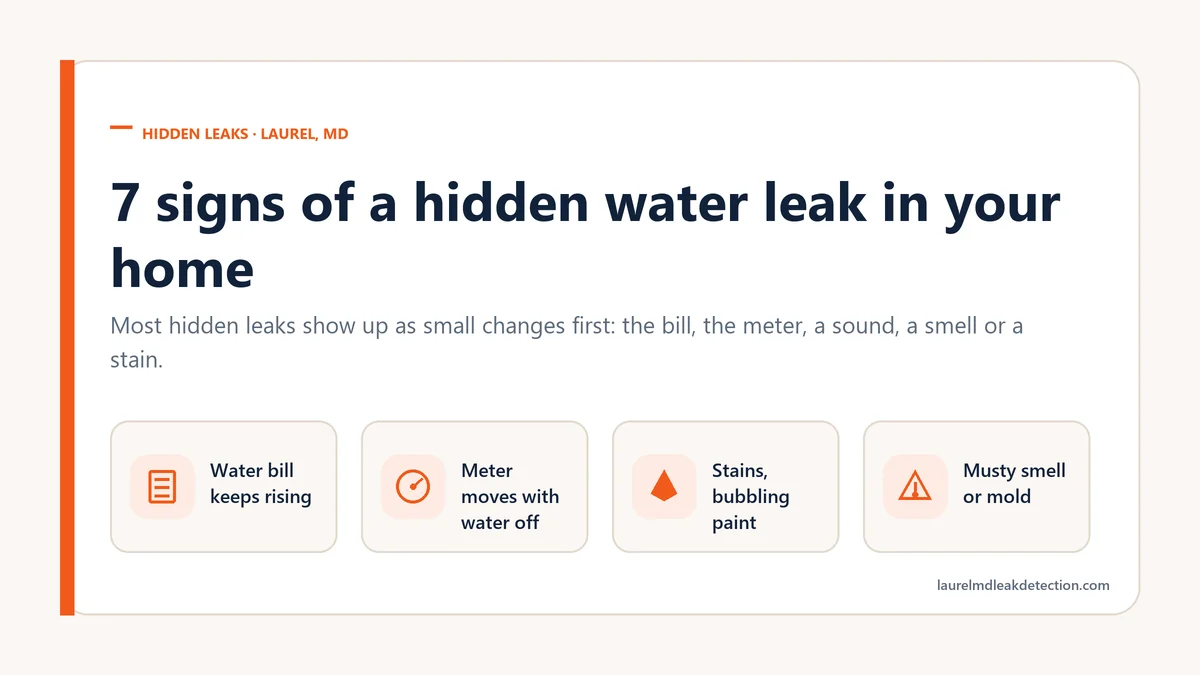
The clearest signs of a hidden water leak are a water bill that rises while your habits stay the same, and a water meter that keeps moving when every fixture is off. Other signs include stains or bubbling paint, a musty smell, the sound of running water, weak water pressure, and warm, damp or soggy spots on floors or in the yard. One sign alone can have another cause; two or more together are a strong reason to have the home checked. If you are in Laurel, MD, our water leak detection service can pinpoint the source without tearing into walls.
Below are the seven signs, what each one usually points to, a one-hour test you can do yourself, and where hidden leaks tend to start.
Why hidden leaks are worth chasing
Hidden leaks are easy to ignore because nothing looks wrong. They still cost money. EPA WaterSense estimates that the average household's leaks can waste more than 9,300 gallons a year, and that about nine percent of homes have leaks wasting 50 gallons or more per day (EPA WaterSense, Fix a Leak Week). The same source notes that fixing easy household leaks can cut water bills by about 10 percent. A leak inside a wall or under a floor also keeps building materials wet, which is how small leaks turn into rot, mold and flooring replacement.
The 7 signs of a hidden water leak
1. Your water bill keeps rising
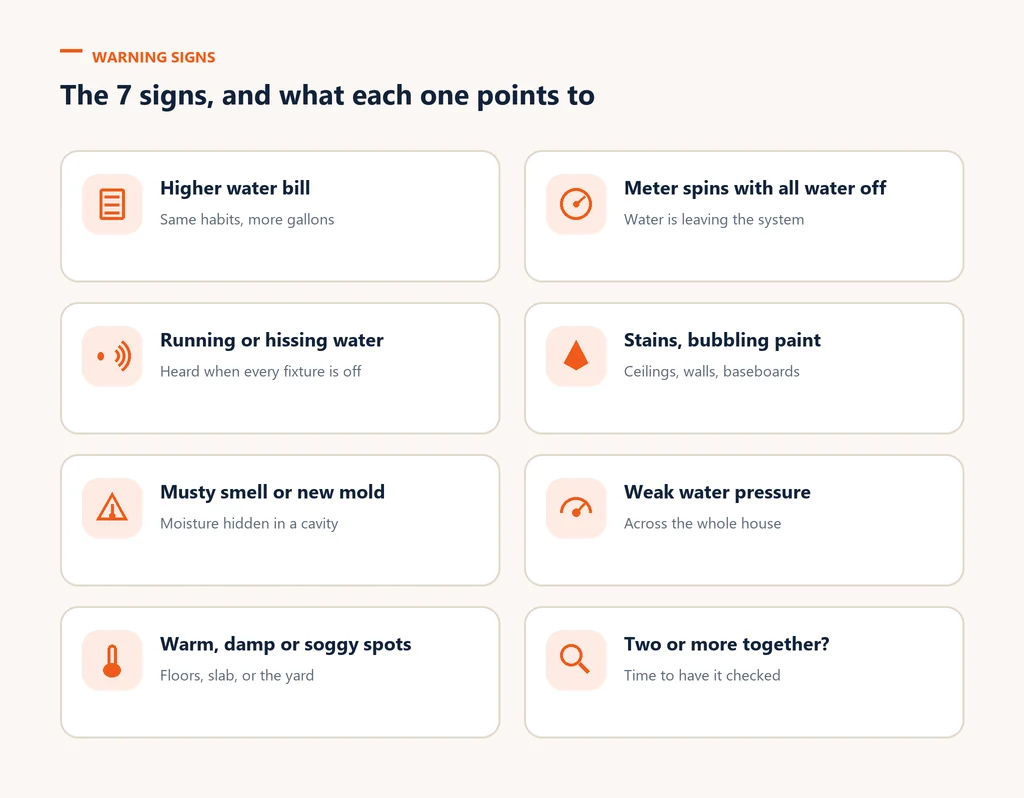
A higher bill with no change in household use is often the first clue. Compare the bill with the same month last year, not last month, because summer watering, guests and holidays change the baseline. A steady climb over two or three billing cycles matters more than one high bill.
2. The water meter moves with all water off
This is the most reliable sign a homeowner can check. Most meters have a small low-flow indicator, often a triangle, star or small dial, that turns when any water passes through. If it turns while nothing in the house is using water, water is leaving the system somewhere. The step-by-step test is below.
3. You hear running or hissing water
Pressurized supply lines can be heard through walls and floors, especially at night when the house is quiet. A hiss or trickle behind a wall, under a floor or near the water heater, with every faucet closed, deserves a closer look.
4. Stains, bubbling paint or soft drywall
Water that runs inside a wall or ceiling shows up as yellow or brown stains, paint that bubbles or peels, drywall that feels soft, and baseboards or trim that swell. Ceilings below bathrooms and walls behind kitchens and laundry rooms are the usual places.
5. A musty smell or new mold
A damp, earthy smell that stays in one room or hallway, even after cleaning, often means moisture is trapped in a wall cavity, under flooring or in a cabinet base. Mold spots at the base of walls or inside sink cabinets point the same way.
6. Water pressure drops across the house
A clogged aerator affects one faucet. Weaker pressure at every fixture can mean water is escaping before it reaches them, for example from a leak on the main service line or under the slab.
7. Warm, damp or soggy spots on floors or in the yard
A warm patch on a tile or concrete floor can sit over a leaking hot-water line under the slab; see what is a slab leak? for the full list of slab signs. Outside, a strip of grass that stays greener or softer than the rest, or a wet area between the meter and the house, can mark a leak on the underground service line.
How to confirm a hidden leak in about an hour
You can confirm whether water is escaping before you call anyone. It takes no tools.
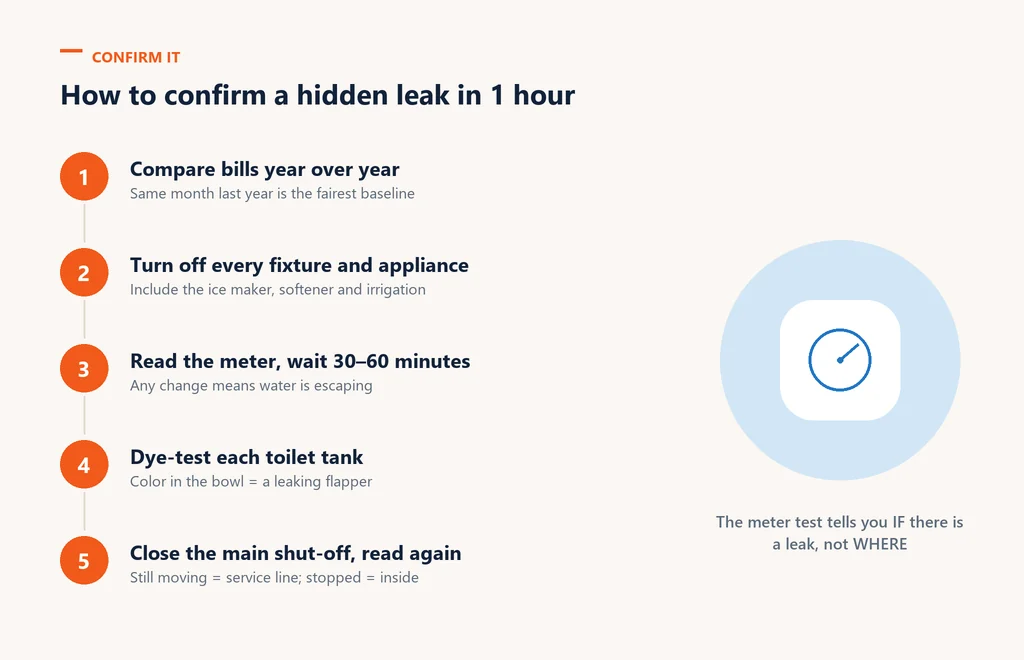
- Compare your bills with the same months last year.
- Turn off every water use: faucets, toilets, the dishwasher, washing machine, ice maker, water softener and any irrigation.
- Read the meter, or photograph it, then wait 30 to 60 minutes without using water and read it again. Any change means water is leaving the system.
- Dye-test each toilet. Put a few drops of food coloring in the tank and wait 15 minutes without flushing. Color in the bowl means a leaking flapper or fill valve, not a hidden pipe leak.
- Close the main shut-off valve at the house and watch the meter again. If it still moves, the leak is probably on the service line between the meter and the house. If it stops, the leak is inside the house's plumbing, which includes lines in walls and under the slab.
A moving meter tells you there is a leak, not where it is. Finding the exact spot is the job of acoustic listening, thermal imaging, moisture mapping and pressure testing, described in how professionals find hidden water leaks.
Where hidden water leaks usually start
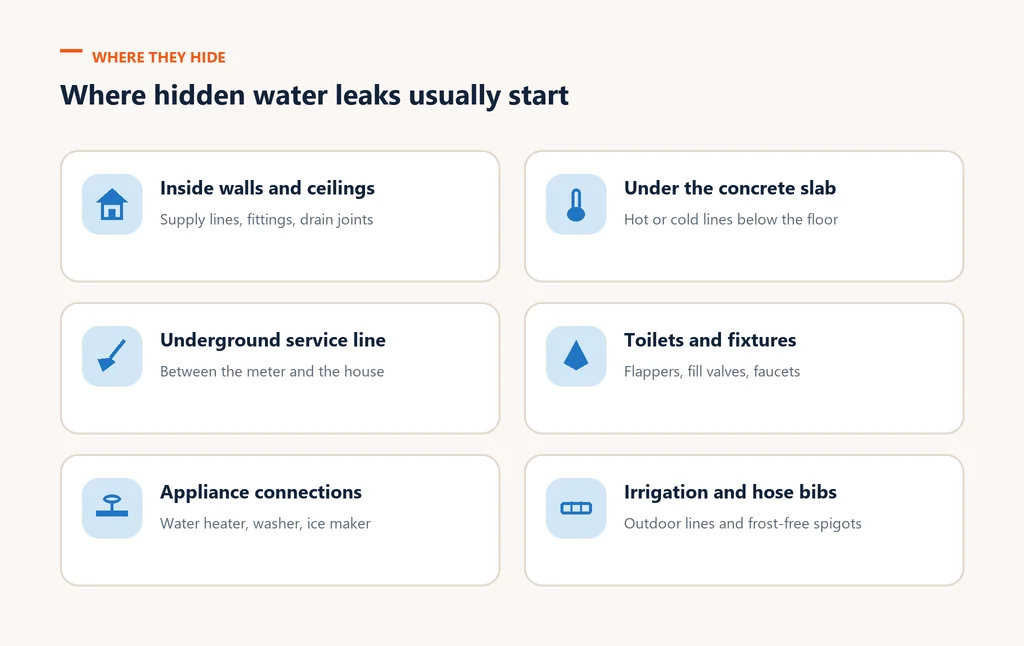
- Inside walls and ceilings: supply lines, fittings and drain joints behind bathrooms, kitchens and laundry rooms.
- Under the concrete slab: hot and cold lines that run below the floor. See our slab leak detection and repair service.
- The underground service line: the pipe between the water meter and the house. See underground water pipe leak detection.
- Toilets and fixtures: flappers, fill valves and dripping faucets.
- Appliance connections: the water heater, washing machine hoses, dishwasher and refrigerator ice-maker lines.
- Outdoor lines: hose bibs and irrigation lines.
Hidden leak checklist, room by room
A ten-minute walk through the house with a flashlight catches most early leaks. Check each spot when the house is quiet:
- Kitchen: the cabinet floor under the sink, the dishwasher toe-kick, and the refrigerator ice-maker line behind the fridge.
- Bathrooms: the floor around the toilet base, caulk and tile around the tub and shower, and the ceiling of the room below.
- Laundry: washing machine hoses (bulges or cracks), the floor behind the machine, and the wall around the supply valves.
- Water heater: the drain pan, the pressure relief valve outlet, and the fittings on top of the tank.
- Basement or crawl space: exposed pipes, pipe joints, the main shut-off valve and any damp concrete near the water line's entry point.
- Outside: hose bibs, the area around the water meter, and any strip of lawn that stays greener or softer than the rest.
Anything damp, stained or corroded on this list is worth a photo and a closer look.
When the sign is not a plumbing leak
Some signs have other causes. Ceiling stains under an attic can come from the roof or from attic condensation rather than a pipe; see roof leak detection. A damp basement floor in humid weather can be condensation or groundwater. The meter test settles most of these questions: condensation, roof leaks and groundwater do not make the water meter move, while a supply-line leak does.
What to do if you find the signs
- Run the meter test above and note the readings.
- If water is visible or the meter is spinning fast, close the main shut-off valve. If a pipe is actively leaking, see how to stop a leaking pipe temporarily.
- Photograph stains, wet areas and the meter for your records and your insurer.
- Do not cut into walls or floors to search for the leak.
- Call us at (301) 872-7888 to schedule water leak detection in Laurel, MD.
Related reading
- Water leak detection services in Laurel, MD
- How do professionals find hidden water leaks?
- What is a slab leak? Signs and causes
- Main water line repair cost: what drives the price
We serve Laurel, MD and nearby neighborhoods, including Downtown Laurel, Laurel Lakes and Muirkirk.