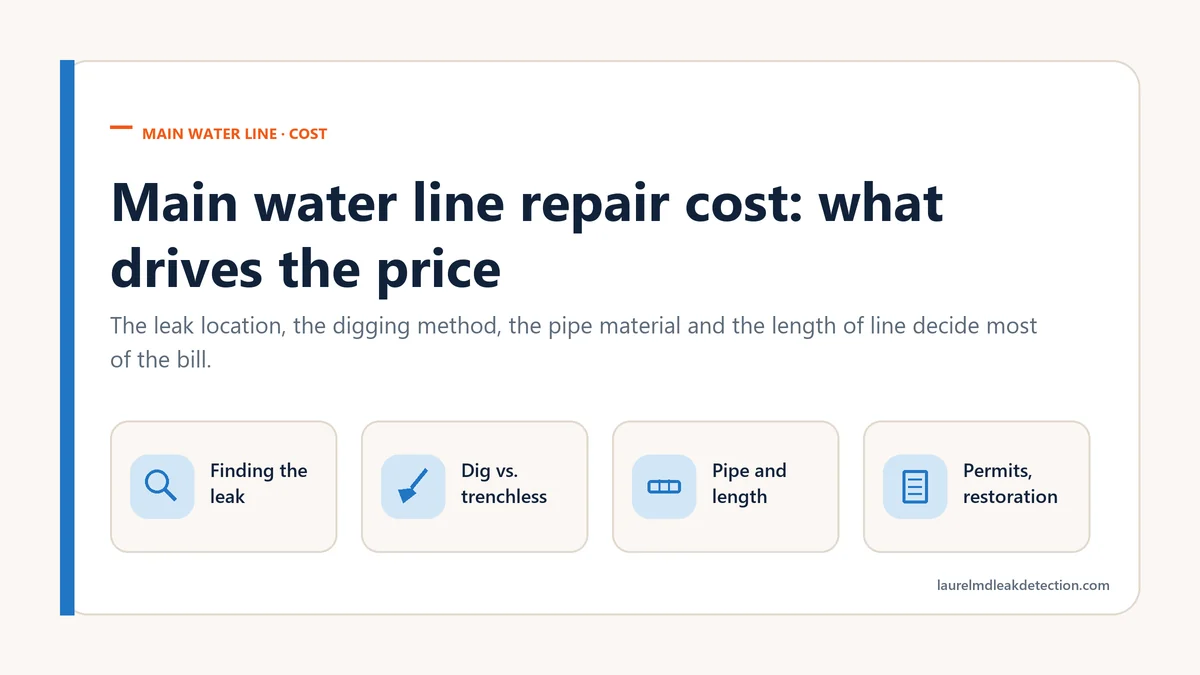
A main water line repair is priced mainly by four things: how precisely the leak is located, whether the pipe is reached by digging a trench or by a trenchless method, the length and material of the pipe being repaired or replaced, and the cost of restoring the driveway, walkway or yard afterward. As a published reference point for our area, Angi's April 2026 data for Washington, D.C. puts the average main water line repair at about $2,020, with a typical range of $915 to $3,219. In Laurel, MD, the first step is to find the leak exactly with underground water pipe leak detection, because that decides how much ground has to be opened.
This guide walks through each cost factor, what published ranges say, who is responsible for which part of the line in WSSC Water areas, and how to compare quotes.
What is the main water line?
The main water line, also called the water service line, is the buried pipe that carries water from the public water main in the street, through the meter, to your house. Leaks on this line often show up as a water meter that keeps moving when the house's main shut-off is closed, a wet or unusually green strip of lawn, low pressure at every fixture, or water seeping near the foundation or the meter. For the causes, see why is my underground water pipe leaking?
What do published cost ranges say?
Cost guides give a useful sense of scale, not a quote. For the Washington, D.C. area, which is the closest published market to Laurel:
| Item (Angi, Washington, D.C.) | Published figure |
|---|---|
| Main water line repair, average | About $2,020 (typical range $915 to $3,219) |
| Damaged pipe section replacement | $500 to $5,000 |
| Main water line replacement, average | About $3,170 (typical range $1,956 to $4,458) |
| Permit | $100 to $500, depending on scope |
Sources: Angi, main water line repair cost in Washington, D.C. and main water line replacement cost in Washington, D.C. (2026 data). Angi's own pages vary, and real quotes depend on the job, so treat these as ballpark figures and get written quotes for your home.
7 factors that decide your price
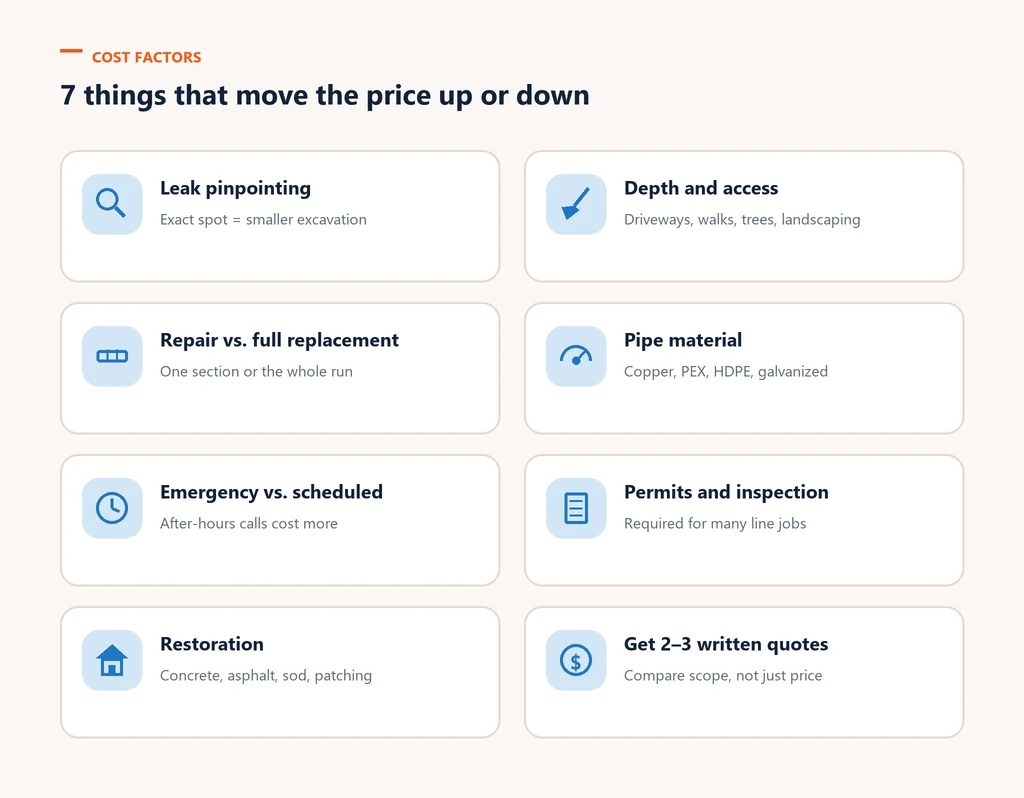
- How precisely the leak is located. A leak pinpointed with acoustic listening, pipe locating and pressure testing needs one small excavation. A guess can mean several holes, or replacing the whole line to be safe.
- Depth and what is on top. A line under a lawn costs less to reach than one under a driveway, walkway, patio, mature tree or retaining wall.
- Repair vs. replacement. Replacing one damaged section costs less than replacing the full run from the property line to the house.
- Pipe material and condition. Copper, PEX, HDPE and older galvanized steel are repaired differently. Corroded galvanized pipe that has leaked more than once is often a candidate for replacement rather than repeated repairs.
- Length of the line. Longer runs from the property line to the house mean more pipe and more labor for any replacement.
- Emergency vs. scheduled work. Night, weekend and holiday calls usually cost more than scheduled work.
- Permits, inspection and restoration. Many line jobs need a permit and inspection, and the bill should say who restores concrete, asphalt, sod and landscaping.
Who pays: WSSC Water or the homeowner?
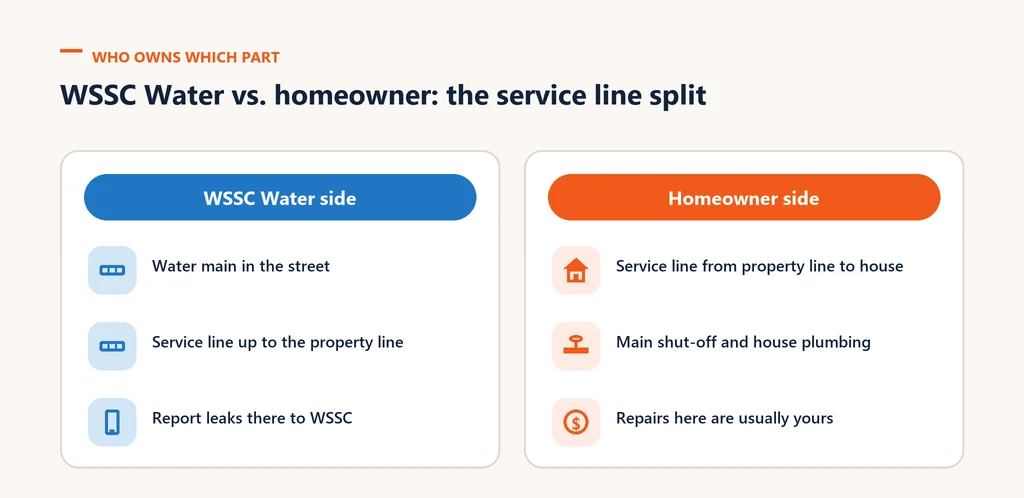
Laurel-area homes are served by WSSC Water, and the service line is split at the property line. WSSC Water says it is responsible for the portion of the service line that connects to the water main and runs to the property line, while the customer owns the portion from the property line into the home (WSSC Water, service line). In practice, a leak in the street or between the street and the property line is reported to WSSC Water, and a leak on the private side is the homeowner's repair. Confirm the details for your address with WSSC before work starts.
Repair methods and how they affect cost
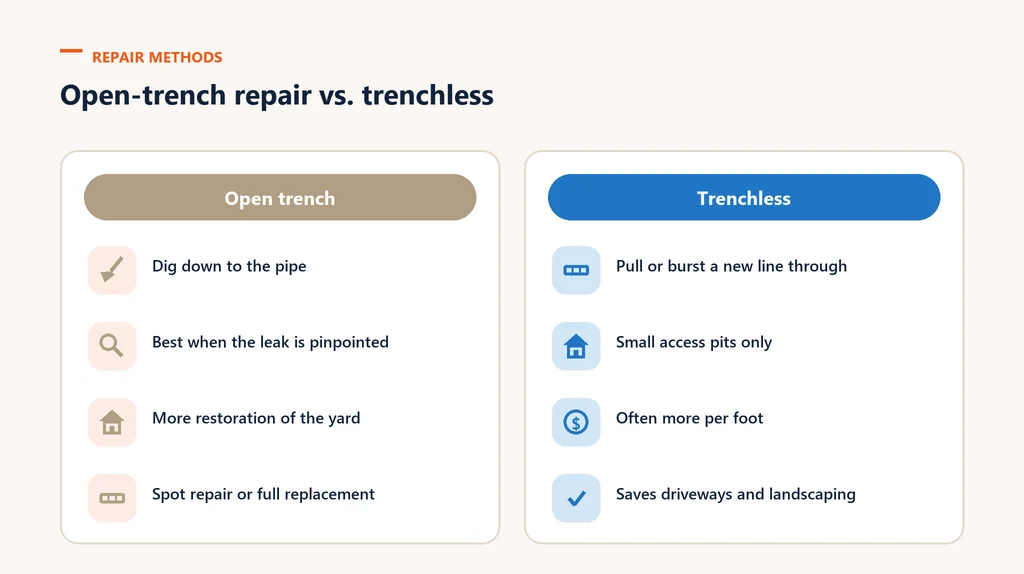
- Open-trench spot repair: dig to the leak and replace the damaged section. Usually the most economical choice when the leak is pinpointed and the rest of the line is sound.
- Open-trench replacement: dig along the line and lay new pipe. More restoration work in the yard.
- Trenchless replacement: pull or burst a new line through small access pits. Often more per foot, but it can save a driveway, walkway or landscaping from being dug up.
We explain the repair side, after detection, on our pipe and water line leak repair page.
Repair or replace: signs the whole line is due
A single leak on an otherwise sound line is usually a spot repair. Replacement becomes the better value when:
- The line has leaked more than once in different places.
- The pipe is galvanized steel or shows heavy corrosion when exposed.
- Water pressure is low across the house and stays low after the leak is fixed, which can mean the pipe is narrowed inside.
- The water comes out discolored or rusty after the line has been sitting.
- Roots, settling or earlier digging have damaged a long stretch of the line.
Accurate leak detection plus a look at the exposed pipe is what tells you which case you are in, so ask whoever opens the ground to photograph the pipe's condition.
Does homeowners insurance cover the main water line?
Standard homeowners policies often exclude the pipe itself as wear and tear, and they treat resulting damage case by case. Some insurers and third parties sell separate service line coverage. Check your policy before the repair; our slab leak and insurance guide explains the sudden vs. gradual rule that most water claims turn on.
How to compare quotes
- Ask each contractor how the leak was located, and whether the price is for a spot repair or a replacement.
- Check the pipe material, the length being replaced and the method (trench or trenchless).
- Confirm who pulls the permit and schedules the inspection.
- Get restoration in writing: concrete, asphalt, sod and cleanup.
- Get two or three written quotes and compare the scope, not only the total.
What to do if you suspect a main line leak
- Do the meter test in 7 signs of a hidden water leak: if the meter moves with the house's main shut-off closed, the leak is likely on the service line.
- If water is surfacing in the yard, keep people and pets away from soft ground.
- If the leak looks like it is on the street side, report it to WSSC Water.
- For the private side, call us at (301) 872-7888 to have the leak located before any digging.
Related reading
- Underground water pipe leak detection in Laurel, MD
- Pipe and water line leak repair
- Why is my underground water pipe leaking?
- 7 signs of a hidden water leak
We serve Laurel, MD and nearby neighborhoods, including Downtown Laurel, Laurel Lakes and Muirkirk.