A slab leak is a leak in a water or drain pipe that runs under or through your home's concrete slab. Because the pipe is hidden in concrete, you rarely see the water. Instead you notice the symptoms: a water bill that keeps rising, a warm or damp spot on the floor, or the sound of running water when everything is off.
This guide explains what a slab leak is, the signs to look for, what causes one, a simple meter test you can do yourself, and what to do next if you live in Laurel, MD.
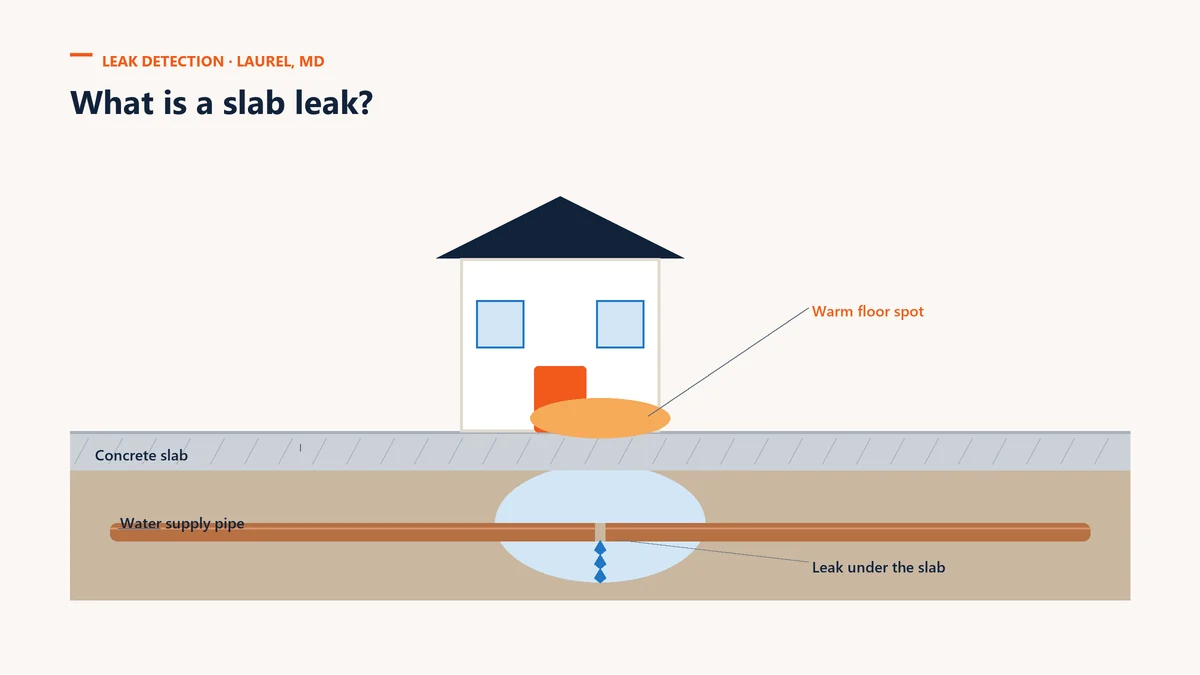
What is a slab leak?
Many homes are built on a concrete slab, and many others have a concrete basement floor. In both cases, water supply lines and drain lines can run below or inside that concrete. When one of those pipes cracks, wears through or separates at a joint, the escaping water has nowhere visible to go. It soaks into the soil and the slab, and it may travel before it shows up anywhere you can see.
There are two kinds of slab leak, and they behave differently:
| Supply-line slab leak | Drain-line slab leak | |
|---|---|---|
| Pipe | Pressurized hot or cold water line | Unpressurized drain or sewer line |
| Leaks | All the time, even when nothing is running | Only when water is drained (showers, laundry, toilets) |
| Typical signs | Rising water bill, moving meter, hissing, warm floor (hot line) | Slow drains, sewage odor, damp floor near bathrooms, repeated backups |
| Meter test | The meter moves with all water off | The meter does not move |
What are the signs of a slab leak?
One sign on its own can have another explanation. Two or more together are a strong reason to have the slab checked.
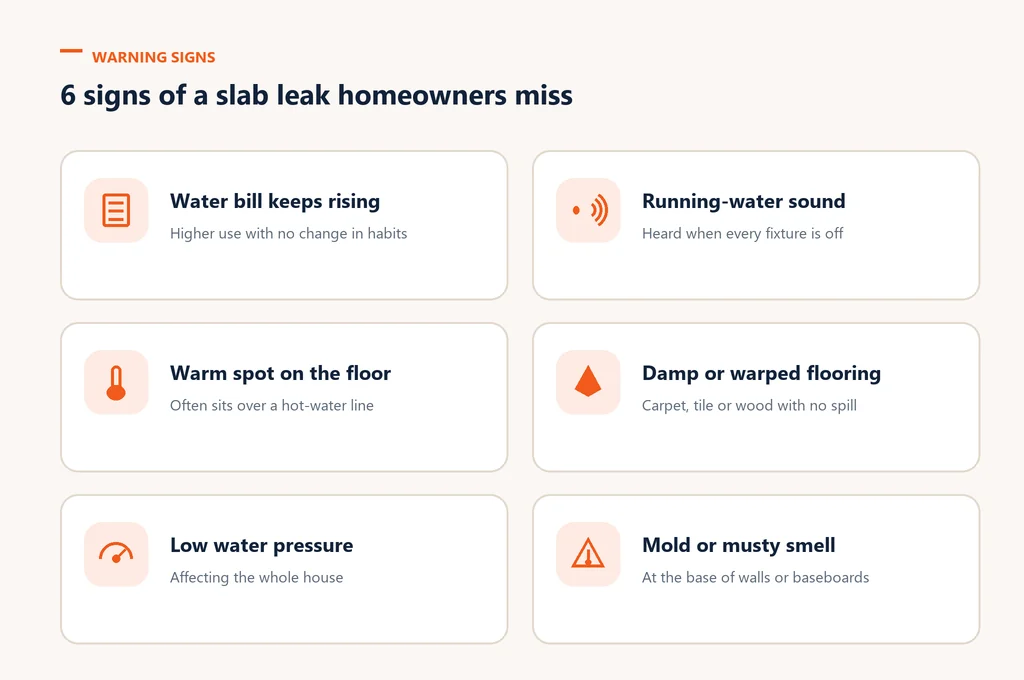
- A water bill that climbs with no change in use. Compare the same months from last year; a steady rise matters more than one high bill.
- Running or hissing water when every fixture is off. Pressurized supply lines are often audible through the floor, especially at night.
- A warm spot on the floor. A leaking hot-water line warms the concrete above it.
- Damp carpet, lifting tile or warped wood flooring with no spill or plumbing fixture nearby.
- A musty smell or mold at the base of walls, or baseboards that keep swelling.
- Lower water pressure across the whole house.
- A water heater that runs more than usual, because it keeps reheating water that is escaping.
- New cracks in the slab or in flooring, which can appear when water washes out the soil below.
Does a warm floor mean a slab leak?
A warm patch that stays in one place while the heating is off is one of the most typical slab leak signs, because hot water escaping under the slab heats the concrete above it. It is not proof on its own: radiant floor heating, a heating duct under the floor, or sunlight through a window can also warm a floor. A warm spot plus a moving water meter or a rising bill is much stronger evidence.
How to tell if you have a slab leak: a simple water meter test
You can check for a hidden supply leak in under an hour without any tools.
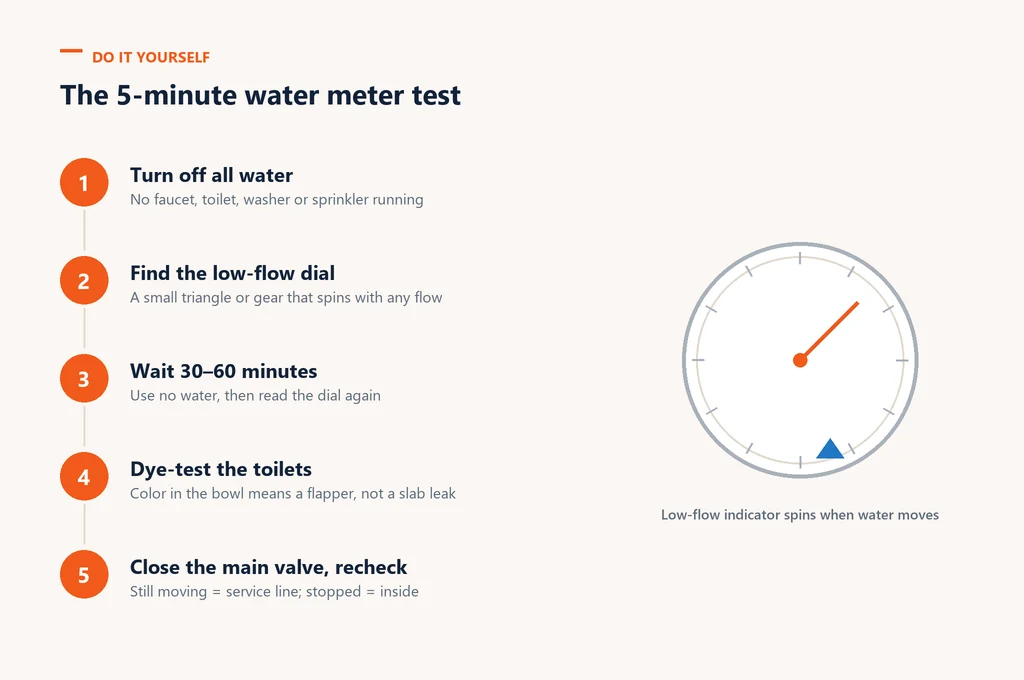
- Turn off all water use. Make sure no faucet, toilet, dishwasher, washing machine, ice maker, sprinkler or water softener is running.
- Read the water meter. Many meters have a small low-flow indicator (often a triangle or star) that spins when any water moves. Write down the reading, or take a photo.
- Wait 30 to 60 minutes without using water, then check again. If the indicator moved or the reading changed, water is leaving the system somewhere.
- Rule out toilets. Put a few drops of food coloring in each toilet tank and wait 15 minutes without flushing. Color in the bowl means a leaking flapper, not a slab leak.
- Close the main shut-off valve at the house and watch the meter again. If it keeps moving, the leak is probably on the service line between the meter and the house. If it stops, the leak is inside the house's plumbing, which includes lines under the slab.
A moving meter tells you there is a leak, not where it is. Finding the exact spot under concrete needs professional equipment, and that is the step that keeps the repair small.
What causes a slab leak?
- Corrosion and age. Metal pipes thin out over the years, and pinhole leaks can form from the inside.
- Abrasion. Pipes that touch concrete, gravel or each other wear down as they expand, contract and vibrate with water flow.
- High water pressure. Pressure that is too high strains joints and pipe walls over time.
- Soil movement. Settling, shifting or washed-out soil under the slab puts stress on buried pipes.
- Installation problems. Kinked, dented or poorly supported pipe and weak joints can fail years after construction.
- Water chemistry. Very hard or aggressive water can speed up pipe wear.
Is a wet slab always a leak?
No. Water on or through a concrete floor, especially a basement floor, can also come from:
- Condensation on cool concrete in humid summer weather.
- Groundwater and drainage, such as rainwater pushing up through the slab or poor grading and gutters sending water toward the foundation.
- A leak somewhere else, like a wall, a window or an appliance, with water running down to the floor.
The quickest way to tell the difference is the meter test above: condensation and groundwater do not make the water meter move, while a supply-line leak does.
What happens if you ignore a slab leak?
A slab leak does not fix itself. Water keeps escaping 24 hours a day on a supply line, so the bill keeps rising and the slab and soil stay wet. Over time that can ruin flooring and baseboards, feed mold inside walls, and soften or wash out soil that supports the foundation. The longer the leak runs, the more materials are affected, and the larger the repair usually becomes.
How is a slab leak found and fixed?
A professional confirms the leak with pressure testing, then pinpoints it without breaking concrete, using acoustic listening, thermal imaging and pipe locating. Our slab leak detection and repair service follows that order so nothing is opened until the location is confirmed. For a closer look at each tool, see how professionals find hidden water leaks.
Once the leak is found, the common repair options are:
- Spot repair: a small, targeted opening in the slab directly over the leak to replace the damaged section.
- Re-routing: running a new line through the walls or ceiling and abandoning the leaking section under the slab, so the concrete is not broken.
- Pipe lining: an epoxy lining inside the pipe, suitable only for some pipes and leaks.
- Repiping: replacing a whole run when the pipe has several leaks or widespread corrosion.
The right choice depends on where the leak is, the pipe material and its condition. Learn more about how we handle the repair on our pipe and water line leak repair page.
What to do if you think you have a slab leak
- Do the water meter test above.
- If water is pooling or the meter is spinning fast, close the main water shut-off valve.
- If a hot-water line may be leaking, turn off the water heater, following its manufacturer's instructions.
- Move furniture, rugs and valuables off wet flooring, and photograph the damage for your insurer. See what homeowners insurance usually covers for a slab leak.
- Do not break up the slab or pull up flooring to look for the leak yourself.
- Call us at (301) 872-7888 to schedule slab leak detection in Laurel, MD.
Related reading
- Is a slab leak covered by homeowners insurance?
- Slab leak detection and repair in Laurel, MD
- Water leak detection services
- Pipe and water line leak repair
- Why is my underground water pipe leaking?
We serve Laurel, MD and nearby neighborhoods, including Downtown Laurel, Laurel Lakes and Muirkirk.